Paying writers per post gets expensive fast, and scheduling those posts eats hours you could spend elsewhere. That math pushes bloggers and agencies toward AI tools with built-in scheduled publishing, where the real question is what each plan actually costs. Autoblogging.ai is one option worth pricing out.
This guide breaks down Autoblogging.ai's monthly and annual plans, credit costs per tier, and the annual savings and rollover value behind each. You will also see what drives the price, which AI modes and features come included, and who should budget for it. By the end, you can decide whether the cost fits your publishing schedule.
What Is Autoblogging.ai? Scheduled Publishing Explained
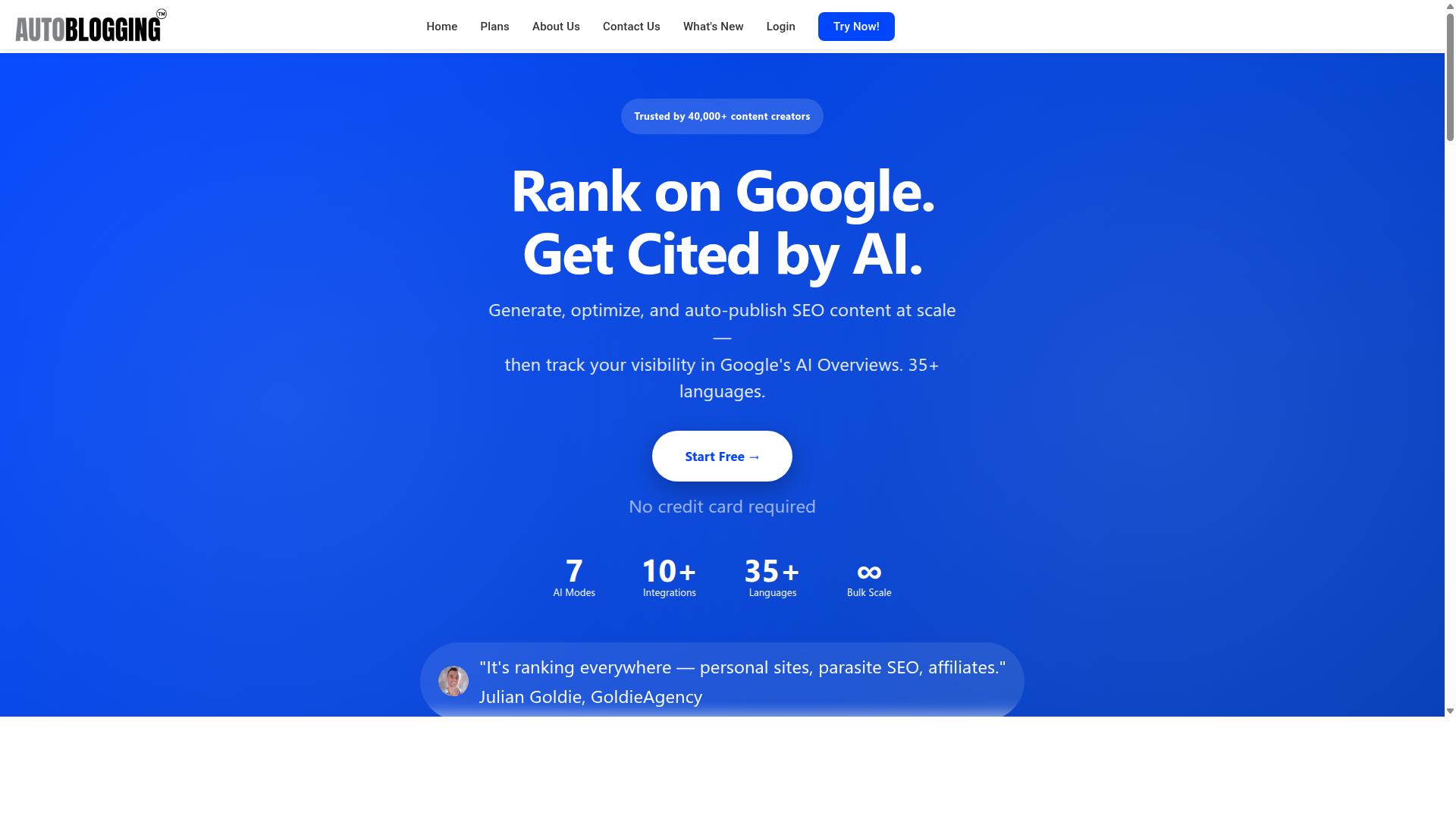
Autoblogging.ai is an AI-powered content automation platform that generates and schedules blog posts, enabling hands-off publishing for websites and blogs. It is a product of Digimetriq.com, built with a clear mission: help bloggers, website owners and agencies save time and improve their online presence through cutting-edge technology.
At its core, the platform handles automated content generation. Users select from AI writing modes, including Quick and Godlike, to produce article drafts without writing from scratch. The stated goal is to cut down content costs and enable human counterparts in their standard operating procedures with a solid first draft.
So what does scheduled publishing actually mean? It means setting a future date and time for a post to go live automatically. Instead of logging in daily to hit publish, you queue content in advance and let the system release it on your behalf.
This matters because consistency drives results in blogging. Search engines and readers both reward sites that publish on a steady rhythm, and manual publishing makes that rhythm hard to maintain. Scheduling removes the bottleneck.
- You choose the date and time for each post
- The platform publishes it automatically when that moment arrives
- Your publishing frequency stays steady even during busy weeks
For content creators, the combination of generation plus scheduling is where the time savings compound. One planning session can fill a content calendar for weeks, and the tool carries out the rest. That is the high-level promise of Autoblogging.ai: less manual effort, more consistent output.
Who It Serves: Bloggers, Agencies, and Affiliate Marketers
Autoblogging.ai is built for bloggers, marketing agencies, affiliate marketers, and other content-driven businesses that need to publish consistently at scale. The platform's stated audience also includes website owners, SEO professionals, and content creators.
Each group uses scheduled publishing for slightly different reasons, but the underlying benefit is the same: blog automation software replaces repetitive manual work with a repeatable process.
- Bloggers, both personal and professional, keep their sites active without writing and publishing every post by hand
- Marketing agencies manage content across multiple client websites from one workflow, which supports scaling production
- Affiliate marketers build out product-focused articles on niche sites and keep them flowing on a schedule
- SEO professionals maintain steady publishing cadences that support keyword targeting and organic visibility
The platform also serves specific site types beyond the standard blog. According to the brand, these include personal sites, parasite SEO, affiliate sites, client websites, portfolio sites, and local sites.
That range says something about flexibility. A solo blogger with one personal site and an agency juggling a dozen client websites are both publishing to the same kind of destination: a website that needs fresh, regular content. Scheduled publishing scales down to the individual and up to the team.
For all of these users, the value proposition is time. Content creation and publishing are ongoing obligations, and handing the repetitive portion to an AI article writer frees people to focus on strategy, promotion, and the human touches that make a site stand out. Autoblogging.ai positions itself as that support layer, not a replacement for the creator's judgment.
How Autoblogging.ai Handles Scheduled Publishing and Automation
Autoblogging.ai streamlines scheduled publishing by combining AI content generation with direct WordPress integration and bulk scheduling capabilities. Instead of writing posts by hand and then remembering to publish them, users move through one connected flow: generate, review, schedule, and let the platform handle the rest.
The process starts with automated content generation. Autoblogging.ai offers several AI article modes, including Quick Mode, Godlike Mode, News Mode, and Amazon Reviews Mode, so the style of output can match the type of site being built. From there, content moves into a scheduling layer that supports bulk generation of up to 500 articles and one-click publishing to WordPress.
For site owners, the practical benefit is a content calendar that fills itself. Rather than publishing everything at once, posts can be drip-fed over days or weeks, which keeps a blog active without a daily manual workload. This matters for publishing frequency, since search engines and readers both respond better to steady output than to sporadic bursts.
Autoblogging.ai also connects beyond WordPress, with publishing support for Web 2.0 platforms such as Medium, Dev.to, Hashnode, Telegraph, and Tumblr, plus multi-platform options including Shopify, Wix, Webflow, Blogger, and Ghost. API access, Zapier, and n8n extend that automation further. The next section breaks down exactly how bulk generation, one-click publishing, and queue management work together.
Bulk Generation and One-Click WordPress Publishing
With Autoblogging.ai, you can generate up to 500 articles in bulk and publish them directly to WordPress with a single click, then schedule them to go live at optimal times. Bulk Generation accepts a CSV, which means a list of topics or keywords can be turned into a full batch of articles in one session rather than one at a time.
Each article can be produced using the platform's different AI modes, so a batch does not have to be uniform. Godlike Mode adds SERP competitor analysis, LSI keywords, and knowledge graph extraction, while News Mode draws on Google News integration for timely topics. That flexibility lets users mix evergreen and current content inside the same queue.
Publishing is where the time savings become obvious. The WordPress integration supports unlimited sites, a plugin, one-click publishing, and scheduled auto-posting. Articles can be pushed to a site as drafts for review or set to publish automatically at a chosen date and time, which removes the copy, paste, and formatting routine entirely.
Scheduling itself comes down to a few moving parts:
- Publish dates and times: assign each article a slot on the content calendar.
- Queue management: keep a running list of pending posts so nothing goes live twice or out of order.
- Drip publishing: spread posts out gradually instead of releasing a whole batch at once.
- Time zone awareness: confirm which time zone the schedule follows so posts land when the target audience is actually reading.
Time zone considerations are easy to overlook. If a site serves an audience in another region, a post scheduled for morning in one zone may publish overnight in another, so it pays to check how the schedule is anchored before committing a large batch.
Queue management keeps that batch organized. With hundreds of articles in play, a visible calendar and clear status for each post prevent gaps, duplicates, and accidental back-to-back publishing. Combined with drip publishing, this turns a single bulk session into weeks of consistent output.
Altogether, bulk generation plus one-click WordPress publishing and scheduled auto-posting can save hours of manual work per batch. The platform also includes optimization tools such as Site Optimizer, Semantic SEO Analysis, Snippet Optimizer, Topical Maps, and AI Infographics, which support the content after it is scheduled. For anyone weighing subscription plans against the hours a manual workflow consumes, that combination is the core value of Autoblogging.ai.
Autoblogging.ai Pricing: Monthly and Annual Plans Compared
Autoblogging.ai offers tiered monthly and annual subscription plans, with pricing based on credits that can be used for article generation. This credit-based pricing model ties what you pay directly to how much automated content generation you actually need, which makes it easier to match a plan to your publishing frequency.
Plans range from a low-cost Starter tier up to a high-volume Enterprise tier, and every level is available on either a monthly or annual basis. Annual billing typically offers savings compared to paying month to month, so the longer commitment rewards users who already know their content calendar will stay busy.
New accounts also receive 10 free credits per month with no credit card required, which functions as a lightweight freemium entry point for testing the platform. If you outgrow your allowance, additional credits can be purchased separately. Payments are accepted via Visa, MasterCard, American Express, and PayPal, with bank transfers available for annual enterprise plans through Stripe, and you can cancel anytime.
The two subsections below break down exactly what each tier delivers and how much annual billing can save you.
Credit Costs per Plan and What Each Tier Delivers
Each Autoblogging.ai plan provides a set number of credits per month, with higher tiers offering more credits and additional features. A credit is the unit used for article generation, so your monthly allowance effectively sets your ceiling on how many pieces of content you can produce.
The monthly plans scale in clear steps, as shown below:
| Plan | Monthly Price | Credits per Month |
|---|---|---|
| Starter | $19 | 40 |
| Regular | $49 | 120 |
| Standard | $99 | 300 |
| Gold | $179 | 600 |
| Premium | $249 | 1,000 |
| Enterprise | $999 | 5,000 |
The jump from Starter to Regular is the first meaningful step for anyone running a small blog, while Standard and Gold suit steadier publishing schedules. Premium and Enterprise target operations that need high-volume automated content generation across multiple sites or niches.
Crucially, all plans include credits rollover. Unused credits do not simply expire at the end of the month, which matters for anyone whose content needs fluctuate rather than staying perfectly flat.
Annual Savings and Credit Rollover Value
Opting for annual billing with Autoblogging.ai can yield significant savings, and the credit rollover feature adds further value by letting unused credits accumulate. The annual plans are billed yearly at a reduced effective monthly rate across every tier.
| Plan | Monthly Price | Annual Price | Annual Total |
|---|---|---|---|
| Starter | $19 | $12/mo | $148/year |
| Regular | $49 | $32/mo | $382/year |
| Standard | $99 | $64/mo | $772/year |
| Gold | $179 | $116/mo | $1,396/year |
| Premium | $249 | $162/mo | $1,942/year |
| Enterprise | $999 | $649/mo | $7,792/year |
The discount is consistent. On Starter, paying monthly would cost $228 over a year, while annual billing comes to $148, a saving of $80. On Enterprise, the gap widens considerably: $11,988 monthly versus $7,792 annually, a saving of $4,196.
Credit rollover compounds that value. If a quiet month leaves credits unused, they carry forward instead of being wasted, giving you flexibility to ramp up during busier periods without buying extra credits. Combined with the ability to cancel anytime, annual billing plus rollover makes the cost and pricing structure predictable for long-term blog automation.
For teams that prefer a fully managed route, Done For You packages are also available: Starter at $1,200 for 1,000 articles, Pro at $1,600, Corp at $4,000, and Senpai at $10,000, each covering 1,000 articles.
What Drives the Cost: AI Modes and Features Included
The cost of Autoblogging.ai is justified by its advanced AI modes and features, including Godlike Mode for SERP analysis and support for 35+ languages. Every subscription tier is built around a simple idea: the more powerful the AI mode and the more credits you need, the higher the monthly pricing. That structure is what separates a basic AI article writer from full blog automation software.
Understanding which modes sit behind which tiers helps you match subscription plans to your actual publishing frequency. It also explains why two users can pay very different amounts for the same platform.
Quick Mode is the entry point and is free, available as a single-article generator and as a wizard. It suits bloggers who want to test automated content generation before committing to a paid plan. This freemium model keeps the barrier low while showing what the platform can produce.
Godlike Mode is where the deeper value lives. It performs SERP competitor analysis, extracts LSI keywords, and pulls knowledge graph data before writing. These capabilities feed directly into SEO optimization and keyword targeting, which is why higher-tier plans that unlock it carry a higher price.
Beyond the two headline modes, Autoblogging.ai includes more than 10 additional modes, and access to premium ones typically scales with your plan level.
- Bulk Generation: produces up to 500 articles at once via CSV, ideal for queue management and drip publishing across large sites.
- News Mode: draws on Google News integration for timely content.
- Amazon Reviews Mode: targets product-focused content.
For anyone running content scheduling at scale, Bulk Generation alone can replace hours of manual work, which is a direct cost offset against the subscription.
Optimization and publishing features are the second cost driver. The platform includes a Site Optimizer, Semantic SEO Analysis with a 21-point audit, a Snippet Optimizer, Topical Maps, Intense Optimizer, Fan Out Queries, AI Infographics, Outreach Prospects, and both an AI Proofreader and a Human Proofreader.
On the publishing side, WordPress integration supports unlimited sites with one-click posting, a plugin, and scheduled auto-posting. Content also flows to Web 2.0 platforms like Medium, Dev.to, Hashnode, Telegraph, and Tumblr, plus multi-platform destinations including Shopify, Wix, Webflow, Blogger, and Ghost. API access, Zapier, and n8n round out the automation stack, and a Content Repurposer extends the life of existing posts.
So how does this connect cost to value? Higher-tier plans generally mean more credits or access to premium modes, and credits are the currency that meters usage limits. If you publish a handful of posts a month, a lower tier with Quick Mode and standard features may be enough. If you run multiple sites with daily output, the premium modes and bulk capacity justify the higher monthly pricing.
Annual billing arrangements and Done For You packages exist for users who want predictable costs or a hands-off setup. The practical advice is straightforward: estimate your monthly article volume, identify which modes you genuinely need, then choose the tier that covers both without paying for capacity you will not use.
Is Autoblogging.ai Worth the Price? Trust Signals and Track Record
Autoblogging.ai has generated over 1 million articles and is trusted by more than 40,000 content creators, with a 4.9 average rating. Those numbers matter in a market where many AI writing tools appear and disappear within a year. A track record of this size suggests the platform has survived real-world use across thousands of blogs, niches, and publishing schedules.
For anyone weighing subscription plans against monthly pricing, the question is not just what a tool costs. It is whether the tool keeps delivering value month after month. A large, active user base and a high average rating are reasonable signals that the answer is yes.
When you evaluate automated content generation software for scheduled publishing, you are committing to an ongoing relationship. The platform has to support your content calendar, your publishing frequency, and your chosen CMS over the long term. Autoblogging.ai's track record points to a product built for that kind of sustained use.
Beyond raw numbers, the company ships new features weekly. That cadence matters because AI writing technology moves fast. A tool that stagnates becomes a liability, while one that updates regularly protects the value of your subscription.
Testimonials from recognized figures add another layer of confidence. Julian Goldie, who runs a YouTube channel with over 250,000 subscribers, has endorsed the platform. James Dooley, known for FatRank and PromoSEO, is another named advocate. These are people whose reputations depend on recommending tools that actually work.
The feature set also explains the pricing. Autoblogging.ai includes 10+ AI modes, support for 35+ languages, and 35+ integrations. It offers one-click WordPress publish, SERP competitor analysis, semantic SEO tools, a 21-point SEO audit, and featured snippet optimization. A human proofreader is included in all plans.
Operational details round out the value picture. Credits rollover, so unused capacity is not wasted. Support is available 24/7. For teams managing content scheduling across multiple sites, these are practical advantages that reduce friction and cost per published article.
Put together, the trust signals, the named endorsements, and the breadth of included features make a clear case. Autoblogging.ai is worth the price for creators who want reliable automated content generation backed by a proven platform.
Who Should Budget for Autoblogging.ai
Autoblogging.ai is a worthwhile investment for bloggers, agencies, and affiliate marketers who publish frequently and value time savings. The platform was built for people who treat content as a recurring workload, not a one-off task, and its target audience reflects that: bloggers, website owners, SEO professionals, marketing agencies, content creators, and affiliate marketers.
If your publishing frequency sits at several posts per week or more, the math tends to work in your favor. The time saved on drafting, formatting, and scheduling usually outweighs the subscription cost, especially once you factor in the consistency that search engines and readers both reward.
Below is a practical breakdown of who gets the most value, and how to think about choosing a plan based on content volume rather than hype.
Bloggers Publishing Multiple Times Per Week
Consistent publishing is one of the hardest habits to maintain. Most bloggers start strong, then slow down when life, work, or writer's block gets in the way. An AI article writer changes that dynamic by removing the blank-page problem from the equation.
If you post two or more times per week, a monthly subscription typically makes more sense than writing everything yourself or hiring freelancers at per-post rates. The value is in volume and rhythm, not in any single article.
Autoblogging.ai serves personal sites and portfolio sites alongside larger projects, so solo bloggers are not priced out of the entry point. A solopreneur can begin with a lower tier and scale up only when publishing frequency demands it.
Think about your realistic output over the next three months, not your best-case week. That number tells you more about which plan fits than any feature comparison.
Agencies Managing Content for Several Clients
Agencies face a different calculation. Every client site needs fresh content, and every delay shows up in reporting. Managing that across five, ten, or twenty properties turns content production into an operational bottleneck.
This is where blog automation software earns its place. Autoblogging.ai explicitly serves marketing agencies and client websites, which means the workflow is designed around managing output at scale rather than a single blog.
Higher tiers make sense for agencies because the cost is distributed across multiple client retainers. A single subscription supporting several properties is far easier to justify than separate tools or freelance contracts per client.
Scalability matters here too. As you add clients, you need a system that absorbs the extra volume without requiring a new hire or a new process every time. That is the core argument for tiered pricing in an agency context.
Local sites, parasite SEO projects, and portfolio sites all fall within the platform's stated use cases, so agencies with varied client rosters are not forced into workarounds.
Affiliate Marketers Running Niche Sites
Affiliate marketing rewards coverage. The more relevant pages you have targeting keyword clusters, the more chances you have to rank and convert. The problem is that niche sites need constant feeding to stay competitive.
Affiliate marketers often run several niche properties at once. Autoblogging.ai lists affiliate sites as a core use case, which fits the reality of managing multiple domains with limited time.
Content scheduling and queue management matter more than raw generation speed for this group. Drip publishing a steady stream of posts looks natural and keeps each site active without manual intervention every day.
Budget-wise, affiliate marketers should treat the subscription as a fixed operating cost against projected commission revenue. If a single site covers the monthly fee, the remaining properties represent upside.
SEO optimization and keyword targeting are part of the broader value here, since the goal is not just publishing but publishing content that has a reason to exist on the site.
SEO Professionals and Content Teams
SEO professionals care about process. Client reporting, content calendars, and predictable delivery windows all depend on a system that does not break down under volume.
Autoblogging.ai fits into that structure by handling automated content generation alongside scheduled publishing. For a team juggling keyword targeting, content calendar planning, and client approvals, removing the manual drafting step frees up hours every week.
Time savings compound across a portfolio. What takes minutes per post in isolation becomes a significant weekly block once you multiply it by the number of sites under management.
CMS compatibility and WordPress integration are common requirements in this space, and they matter because content that cannot be published smoothly is not really finished.
For SEO teams, the decision usually comes down to whether the tool reduces coordination overhead. When publishing runs on a schedule rather than on reminders, the whole workflow tightens.
Matching Plans to Content Volume
Choosing a plan should start with one question: how much content do you actually need to publish each month? Everything else follows from that number.
- Solopreneurs and new bloggers: start with a lower tier such as Starter and upgrade only when output consistently hits the ceiling.
- Growing affiliate sites: mid-tier plans suit owners running a handful of properties with steady publishing frequency.
- Agencies and multi-site operators: higher tiers fit client work, where volume is higher and the cost is spread across retainers.
- SEO teams: choose based on total sites managed and the publishing cadence promised to clients.
Usage limits are the practical constraint to watch. If you regularly approach your cap, that is the signal to move up rather than to ration posts and slow your schedule.
Annual billing is worth considering once your volume is stable, since it typically reduces effective monthly pricing. New users can also evaluate the platform through a free trial or freemium model before committing to a paid tier.
Autoblogging.ai is available worldwide, so location does not limit access. What matters is matching tiered pricing to real publishing frequency, not to ambition.
The clearest verdict for this audience: if you publish often, manage more than one site, or bill clients for content, the subscription pays for itself through time saved and consistency gained. Bloggers, agencies, affiliate marketers, and SEO professionals all sit squarely in that group, and the platform's stated target audience confirms it was designed for exactly these users.
Final Verdict: Cost and Value for Scheduled Publishing
Autoblogging.ai offers a robust scheduled publishing solution with transparent, credit-based pricing that scales from solo bloggers to large agencies. The platform pairs automated content generation with content scheduling, so publishing frequency stays consistent without constant manual effort.
That combination is the real value proposition. You are not paying for a writing tool and a calendar tool separately. One subscription handles both, which saves time and keeps your content calendar moving even during busy weeks.
Pricing starts at $19/month, with credits that roll over so unused capacity is not wasted. Annual billing brings further savings for anyone committed to regular output. For a full breakdown of tiers, see the cost and pricing guide sections above.
Key benefits at a glance:
- Bulk generation for producing multiple articles in one session
- WordPress integration for publishing to a familiar CMS
- Advanced AI modes for different content needs
- Credit rollover that protects unused spend
For bloggers and agencies that publish on a fixed schedule, the math tends to work in the tool's favor. Replacing even part of a manual writing workflow with blog automation software frees hours each month. Those hours usually cost more than the subscription itself.
The tiered pricing also means you are not overpaying early on. Start small, then move up as your queue grows. That flexibility matters when publishing volume changes from month to month.
Is it worth the price? For anyone who needs to publish regularly, yes. The credit-based model keeps costs predictable, rollover prevents waste, and annual billing rewards commitment. It is a practical fit for solo bloggers, marketing teams, and agencies managing multiple sites.
If you have questions about subscription plans, billing, or which tier suits your publishing frequency, reach out directly. Autoblogging.ai is based in India at 501, Trinity Orion, Vesu, Surat - 395007, Gujarat, India, reachable by phone or WhatsApp at +91 84605-06553 or +91-8460506553, and by email at [email protected]. Skype contact is vibes.yb, with support hours of 7:00-19:00 IST.
There is also a United Kingdom office at 2nd Flr, SEO Content Suite, 35 Water Ln, Wilmslow, Cheshire SK9 5AR, reachable at +44 1625 359056. You can follow updates on Facebook, Twitter, and LinkedIn. For a tool built around scheduled publishing, that level of accessible support rounds out the value.
Frequently Asked Questions
How much does Autoblogging.ai cost, and what do the plans include?
Autoblogging.ai offers monthly plans starting at $19 for 40 credits and scaling up to $999 for 5,000 credits, with tiers in between including Regular ($49/120 credits), Standard ($99/300 credits), Gold ($179/600 credits) and Premium ($249/1,000 credits). Annual plans are also available and are billed yearly, so you can choose the billing cycle that suits your publishing schedule. Every plan runs on the same AI article generation platform, so you can start small and upgrade as your content needs grow.
What exactly is a "credit," and how many articles can I publish per month?
Credits are the unit you spend to generate content with Autoblogging.ai, and each plan includes a set number of them per billing cycle. Because different AI modes and article types can consume credits differently, the number of finished articles you get depends on how you use the platform. A useful benefit is that credits roll over, so unused credits aren't automatically lost at the end of a cycle.
Can I schedule articles to publish automatically, or do I have to post them manually?
Autoblogging.ai is built for scheduled publishing workflows, so you can generate content in advance and have it go out on your timeline rather than publishing everything by hand. With Bulk Generation you can produce up to 500 articles via CSV, which pairs well with a scheduled publishing calendar. For the exact scheduling and integration options available on your plan, it's best to check the current feature list or contact support.
Which AI modes are included, and does the price change based on the mode?
Autoblogging.ai includes more than 10 AI modes, such as Quick Mode (free, single and wizard), Godlike Mode (with SERP competitor analysis, LSI keywords and knowledge graph extraction), Bulk Generation, and News Mode. Quick Mode is free, while other modes draw on your plan credits, so your effective cost depends on which modes you rely on. If you mainly use lighter modes, a smaller plan may be enough; heavier use of advanced modes generally calls for a larger credit package.
Are there cheaper alternatives, and is it worth paying for Autoblogging.ai?
Pricing across AI autoblogging tools varies widely, and the cheapest option isn't always the best value once you factor in output quality, supported languages and integrations. Autoblogging.ai is trusted by 40,000+ content creators with a 4.9 average rating and over 1M articles generated, and it supports 35+ languages and 35+ integrations. It also includes a human proofreader and 24/7 support, with new features shipped weekly - factors worth weighing against a lower sticker price elsewhere.
Is there a free option, and can I try Autoblogging.ai before committing to a paid plan?
Yes - Quick Mode is free and available in both single and wizard formats, so you can generate content and get a feel for the platform before paying. When you're ready to scale, paid monthly plans start at $19, and annual billing is available if you'd prefer to pay yearly. If you're unsure which tier fits your publishing volume, you can reach the team at [email protected] or via phone/WhatsApp at +91 84605-06553.
Recommended Resources: